1. Divisions of the Skeletal System
The skeletal system includes all of the bones, cartilages, and ligaments of the body that support and give shape to the body and body structures, whereas the skeleton consists of the bones of the body. For adults, there are 206 named bones in the skeleton. Younger individuals have higher numbers of bones because some bones fuse together during childhood and adolescence. The primary functions of the skeleton are to provide a rigid, internal structure that protects internal organs and supports the weight of the body, and to provide a structure upon which muscles can act to produce movements of the body. The bones of the skeleton also serve as the primary storage site for important minerals such as calcium and phosphate. The bone marrow found within bones stores fat and houses the blood-cell producing tissue of the body.
The skeleton is subdivided into two major divisions—the axial and appendicular.
The Axial Skeleton
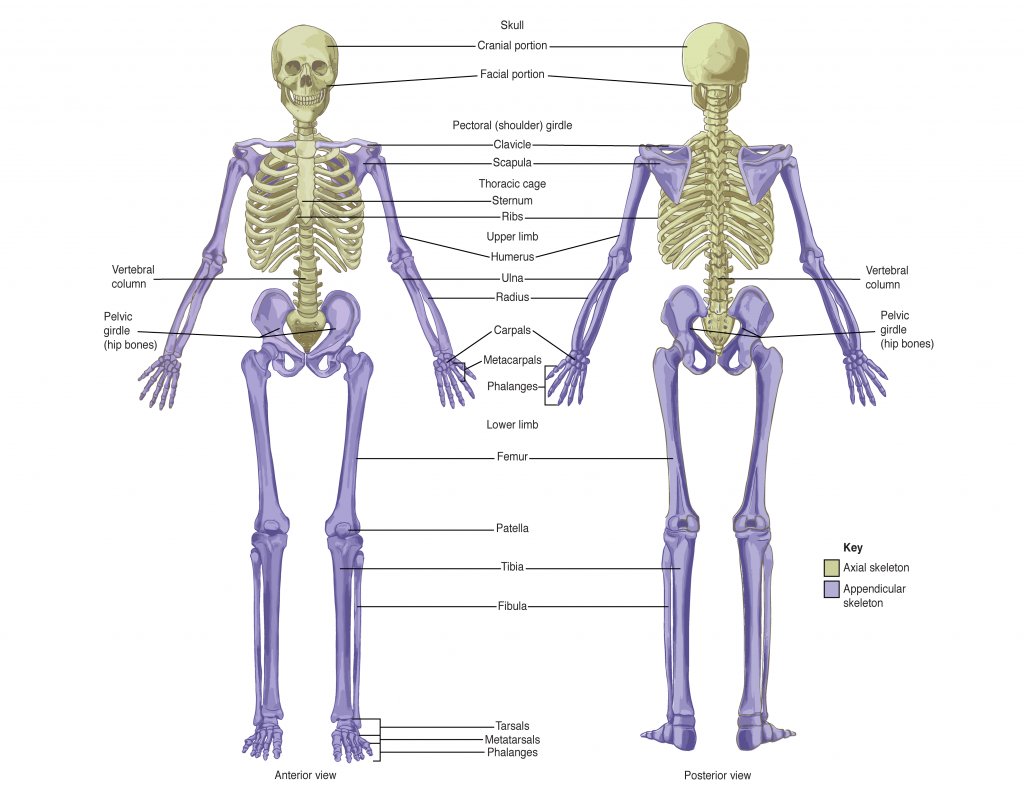
The axial skeleton forms the vertical, central axis of the body and includes all bones of the head, neck, chest, and back (see Figure 1). It serves to protect the brain, spinal cord, heart, and lungs. It also serves as the attachment site for muscles that move the head, neck, and back, and for muscles that act across the shoulder and hip joints to move their corresponding limbs.
The axial skeleton of the adult consists of 80 bones, comprising the skull, the vertebral column, and the thoracic cage. The skull is formed by 22 bones. Also associated with the head are an additional seven bones, including the hyoid bone (found in the upper neck) and the ear ossicles (three small bones found in each middle ear). The vertebral column consists of 24 bones, each called a vertebra, plus the fused vertebrae of the sacrum and coccyx. The thoracic cage includes 12 pairs of ribs, and the sternum, the flattened bone of the anterior chest.
The Appendicular Skeleton
The appendicular skeleton includes all bones of the upper and lower limbs, plus the bones of the pectoral and pelvic girdles that attach each limb to the axial skeleton. There are 126 bones in the appendicular skeleton of an adult. The lower portion of the appendicular skeleton is specialized for stability during walking or running. In contrast, the upper portion of the appendicular skeleton has greater mobility and ranges of motion, features that allow you to lift and carry objects. The bones of the appendicular skeleton are covered in a separate chapter.